


When Purpose Challenges Peace
In our second week, we explored the Land of Discipleship and the ways that the rhythms of faith, church, Scripture, service, and community can give our lives meaning. We also considered how the good things about this land can develop a shadow side, eventually turning our homeland into an island. Through our fictional friends Joe and Susie, we began to see how two people can share the same church community while experiencing their faith in very different ways.
This week, we're adding two more friends to the journey: Dave and Charlotte. Like Joe and Susie, they have different experiences of faith, different expectations, and different ideas about what it means to follow Jesus.
Fixing Our Thoughts on God
But before we meet them, I want to invite you to do something a little different, starting with this beautiful reminder from Isaiah:
You will keep in perfect peace
all who trust in you,
all whose thoughts are fixed on you!
Regardless of where we find ourselves on the spiritual journey, we need to continually fix our thoughts on God. Sometimes that means slowing down long enough to notice what's happening within us. To recognize where we are experiencing the presence of God's Spirit and where we may be struggling to see it.
One way to do this is through a simple spiritual temperature check.
Spiritual Temperature Check
Take a few minutes to become still. Find a quiet place, take a few slow breaths, and invite God to help you pay attention to your spiritual life. You might begin with a simple prayer:
God, help me see what is happening within me. Show me where your Spirit is bearing fruit, where I am growing, and where I may need your presence and guidance.
Then slowly consider the fruit of the Spirit described in Galatians 5:22–23.
- Love
- Joy
- Peace
- Patience
- Kindness
- Goodness
- Faithfulness
- Gentleness
- Self-control
As you reflect on each quality, consider how present it seems in your life right now. You might mark each one as strong, neutral, or weak. Don't overthink your answers, and resist the temptation to grade yourself. This isn't a spiritual report card. It's simply an opportunity to notice what's happening within you.
- Where are you experiencing the fruit of the Spirit?
- Where might you be longing for more?
If you're comfortable, take a moment to write down what stands out. You might even share one or two observations with someone you trust.
As you finish, consider whether there is a connection between the fruit you're experiencing and your sense of spiritual peace.
Sometimes we discover that we're experiencing a deep sense of peace even in the midst of difficult circumstances. Other times, we realize that something has been disrupting our peace, perhaps without our fully recognizing it.
The goal isn't to manufacture peace or force ourselves to feel a certain way. It's to become more attentive to what is happening within us and to invite God to expand our awareness.
New Friends and New Homelands
Let's return to our map of the spiritual journey. This week, we're introducing two new friends who call very different places home.
First, meet Dave.

Dave is a brand-new follower of Jesus. He didn't grow up in the church, and he had a rough go of it during his teens and early twenties. But when he discovered Jesus, it was like someone had hit the reset button on his life. His past was behind him, and each day felt like a tremendous gift. Now he's enthusiastic about the future and eager to share the life-changing secret of knowing Jesus.
Dave calls the Horizon of Awakening home.
Now meet Charlotte. (if you haven’t noticed our AI image generator loves to dress people in olive green)

Charlotte has known about Jesus for a long time. She comes from a family of faithful parents and grandparents and has been attending church for as long as she can remember. When her children were born, she couldn't wait for the church to bless each new child. Now those little babies are nearly grown, and it seems like Senior Sunday was just around the corner!
Over the years, Charlotte has also found meaningful ways to serve. She sings on the praise team, volunteers in multiple ministries, and even started a brand-new ministry at church a few years ago. She loves being involved and finds great purpose in using her gifts to serve others.
Charlotte calls the Plains of Purpose home.
Dave and Charlotte have very different experiences of faith. Neither is necessarily better or worse. But the place they call home shapes what they notice, what they value, and what they expect from their life with God.
That can shape the ways they experience and store up peace.
Take a moment to imagine how Dave and Charlotte might respond to the spiritual temperature check we just completed. What qualities might stand out in each of their lives? What might they be experiencing differently?
Remember, these homelands aren't rankings, and they aren't a measure of how close someone is to God. They simply help us recognize the different ways people experience and live out their faith.
The Plains of Purpose
When we move from learning and practicing our faith to actively putting our gifts to work, we may find ourselves traveling into what Hagberg and Guelich describe as the Productive Life. We're calling this place the Plains of Purpose.
This is the doing stage.
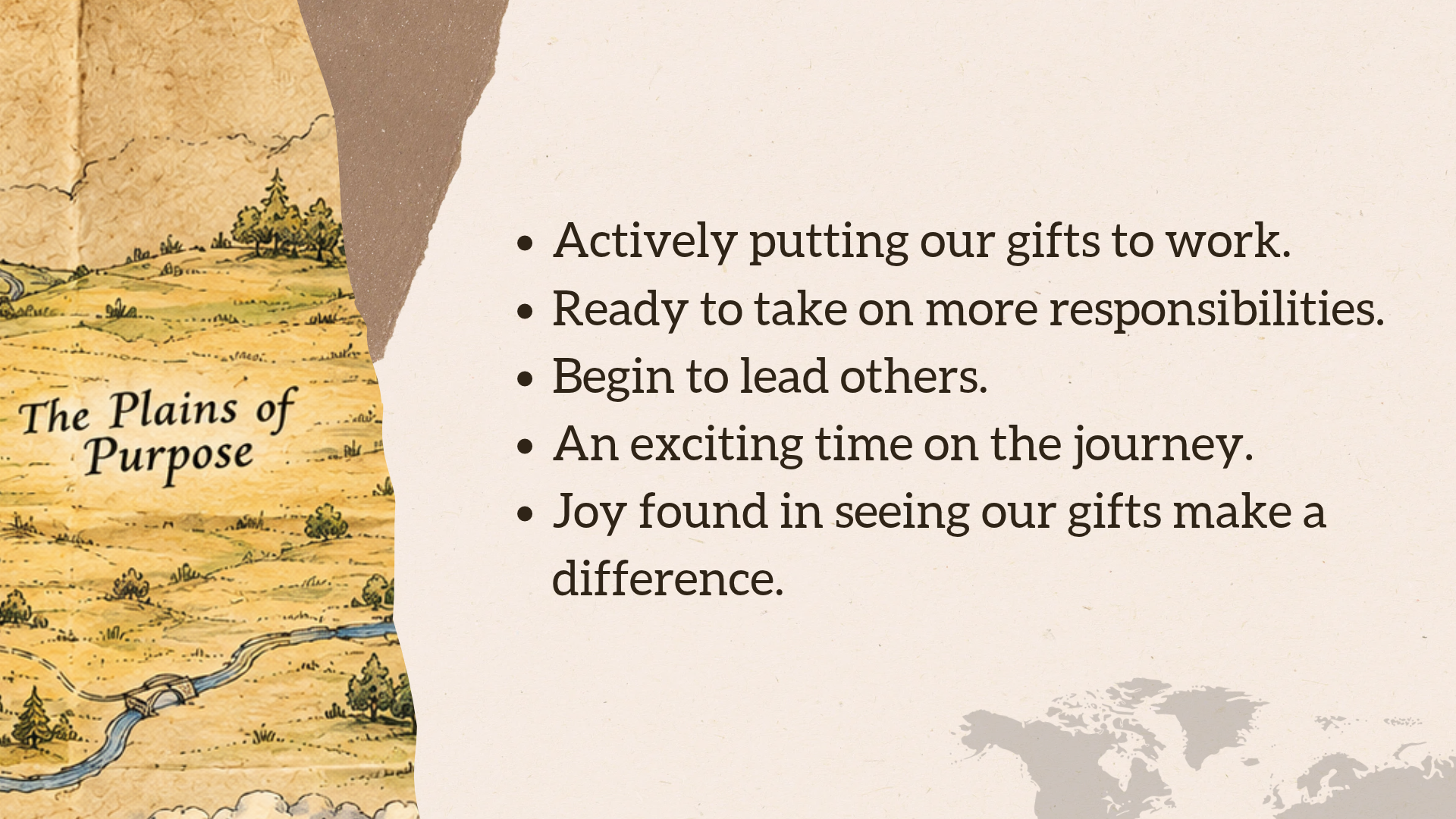
Having spent time learning to follow Jesus, we begin to feel ready to take on more responsibility. We discover our gifts, find opportunities to serve, and begin to lead others. We teach classes, lead ministries, organize events, care for people, and take on responsibilities within the church and beyond it.
This can be an exciting and fulfilling time in our faith. We see the difference our efforts can make. We feel useful. We find purpose in using our gifts to serve God and others. Our faith isn't just something we believe or practice. It becomes something we actively do.
Think about someone who has spent years participating in a church community and finally agrees to teach a Bible class. Or someone who has served behind the scenes and is invited to lead a ministry. Maybe it's a young adult who begins to recognize their gifts and discovers how those gifts can make a difference in the lives of others.
These can be wonderful experiences. We experience the joy of serving, the satisfaction of seeing something grow, and the fulfillment of knowing that we're contributing to something bigger than ourselves.
Now think about Charlotte. She has spent a lifetime in the church, raised her children in the community of faith, found meaningful ways to serve, and even helped create a new ministry. These things aren't just activities on her calendar. They're part of how she understands her faith and her relationship with God.
She finds purpose in using her gifts, and she experiences the joy of seeing those gifts make a difference.
The Plains of Purpose can be a place of deep peace because we find meaning in using our lives to serve God and others.
But there's a tension here. The very things that make this stage so fulfilling can also become sources of struggle.
The things that bring us purpose and peace can also become the things we expect everyone else to value. And when they don't, we may begin to misunderstand one another.
Charlotte may not even realize she's doing it. What has become meaningful and life-giving to her may begin to feel like the natural expectation for everyone else.
Think about how that might affect her relationship with someone like Dave. She may appreciate his enthusiasm and new love for Jesus, but she might also wonder why he isn't more involved in the life of the church. Why isn't he serving? Why isn't he taking advantage of the opportunities available to him?
From Charlotte's perspective, these things are simply part of what it means to live faithfully.
But Dave is experiencing something different. He's still discovering the joy of knowing Jesus. His excitement isn't necessarily expressed through the same responsibilities or activities that have become meaningful to Charlotte.
Our experience of faith can shape what we expect from others, sometimes without our even realizing it.
When Purpose Becomes a Source of Struggle
When our work is going well, we may begin to expect that it will continue to go well. We assume that if we work hard enough, pray faithfully enough, or lead well enough, we'll see the results we hope for.
We may also begin to tie our sense of worth to what we accomplish.
We feel close to God when our work is fruitful, but wonder what has gone wrong when it isn't.
We might become frustrated when people don't change, when our efforts go unnoticed, or when someone else is chosen to lead. We may even begin to expect everyone else to work as hard as we do.
The work itself isn't necessarily the problem. Serving God and others is good. But our relationship with that work can change.
We can begin to measure our faithfulness by what we accomplish, or measure the faithfulness of others by how much they contribute. What once brought us joy and purpose can become a source of pressure, frustration, and even resentment.
There are many stories throughout scripture that reflect this reality, but one of my favorite examples is from the Gospels.
Martha and Mary
As Jesus and his disciples were on their way, he came to a village where a woman named Martha opened her home to him. She had a sister called Mary, who sat at the Lord's feet listening to what he said. But Martha was distracted by all the preparations that had to be made. She came to him and asked, "Lord, don't you care that my sister has left me to do the work by myself? Tell her to help me!"
"Martha, Martha," the Lord answered, "you are worried and upset about many things, but few things are needed, or indeed only one. Mary has chosen what is better, and it will not be taken away from her."
It's easy to read this story as a warning against being busy. But Martha's hospitality isn't bad, and serving others isn't the problem.
We might imagine Martha as someone who would feel right at home in the Plains of Purpose. She knows how to serve, she sees what needs to be done, and she takes responsibility for making things happen. Those are good qualities.
The tension emerges when Martha becomes so caught up in what needs to be done that it begins to affect her relationship with Jesus and with Mary.
Martha becomes frustrated and asks Jesus to tell Mary to help her. From her perspective, Mary isn't doing what she should be doing. She's not sharing the responsibility, and Martha feels left alone to carry the load.
It's possible that Charlotte would relate to Martha. She knows what it takes to make things happen. She has spent years serving, leading, and taking responsibility. But what happens when she begins to measure her own faithfulness, or the faithfulness of others, by how much they're doing?
We can experience something similar in our own lives.
We can become so focused on serving God that we lose sight of the God we are serving.
We can become so invested in doing good things that we struggle when others don't share our priorities or when our efforts don't produce the results we expected.
The question isn't whether we should serve. It's what happens within us as we serve.
Finding Our Way Back to Peace
The Plains of Purpose isn't a place we need to avoid. Using our gifts, serving others, and accepting responsibility can be meaningful expressions of our faith. We shouldn't confuse the challenges of this homeland with a reason to abandon the good things God is doing through us.
Instead, we need to pay attention to what is happening within us.
- Are we serving out of love, or are we trying to prove our worth?
- Are we finding joy in what God is doing, or becoming frustrated because things aren't going the way we planned?
- Are we able to appreciate the different ways others are following Jesus, or have our own expectations become the standard by which we measure everyone else?
These are important questions, especially when we find ourselves losing the peace we once experienced in serving God.
Remember the spiritual temperature check we began with? This is a good place to return to it.
Practice: Returning to the Source
Take another look at the fruit of the Spirit. Have any of your observations changed as you've reflected on the Plains of Purpose and the story of Martha and Mary?
Perhaps you recognize that your patience has been wearing thin. Maybe you've been struggling with joy because your efforts haven't produced the results you hoped for. Or perhaps you've realized that you've been so busy caring for others that you've neglected your own relationship with God.
Whatever you notice, resist the urge to immediately fix it or turn it into another project. Instead, bring it honestly before God.
You might spend a few minutes praying with these questions:
- Where am I finding purpose and joy in serving God and others?
- Where might my work or responsibilities be becoming a source of frustration or pressure?
- Am I measuring my worth, or the worth of others, by what we accomplish?
- What might it look like to sit at the feet of Jesus again, remembering that my relationship with God is not dependent on what I do?
You might even spend some time simply sitting in silence, releasing the things you feel responsible for and receiving the reminder that you are loved by God apart from what you accomplish.
The goal isn't to do less for the sake of doing less. It's to remember why we do what we do in the first place.
The peace we find in serving God isn't ultimately found in how much we accomplish, how much responsibility we carry, or how successful our efforts become. It comes from our relationship with the God we are serving.
Learning to Appreciate Different Journeys
As we close this week, I want to return to our four friends: Joe, Susie, Dave, and Charlotte.
Each of them calls a different place home. Each has different experiences, different expectations, and different ways of understanding what it means to follow Jesus.

What brings one person peace might frustrate another. And sometimes the people who could help us find peace are the very people we struggle to understand.
Perhaps one of the most important things we can learn along this journey is to appreciate what God is doing in someone whose experience of faith looks different from our own.
We don't all need to be in the same place. We don't all need to express our faith in the same way. And we certainly don't need to measure someone else's journey by the expectations we've developed along our own.
Wherever we find ourselves, we can continue learning to fix our thoughts on God, trusting that God is with us and is still at work within us.
You will keep in perfect peace
all who trust in you,
all whose thoughts are fixed on you!
– Isaiah 26:3