
Storing Up Peace: The Journey Begins

Ben Crain • Youth Minister
October 20, 2026

7 Minute Read


Storing Up Peace: The Journey Begins

What if finding peace begins with remembering that God is with us, wherever we are on the journey?

“When I experienced peace I knew God was with me.”

Those words from Kellie White recently gave me a way to express what I hope we will discover together over the next several weeks.

We often think of peace as the absence of conflict, the resolution of a problem, or the moment when life finally settles down. But what happens when the problem remains, the conflict continues, or life takes us somewhere we never expected to be?

Can we experience peace even there?

I believe we can. Storing up peace for our spiritual journey begins with realizing, or remembering, that God is with us.

God Is With Us, Wherever We Go

Read Psalm 139

Find a quiet place, or your favorite spot to spend time with God, and read all of Psalm 139 aloud. Read slowly. Pause whenever a line or phrase catches your attention, and spend a little time reflecting on it. When you finish reading, return to this post.
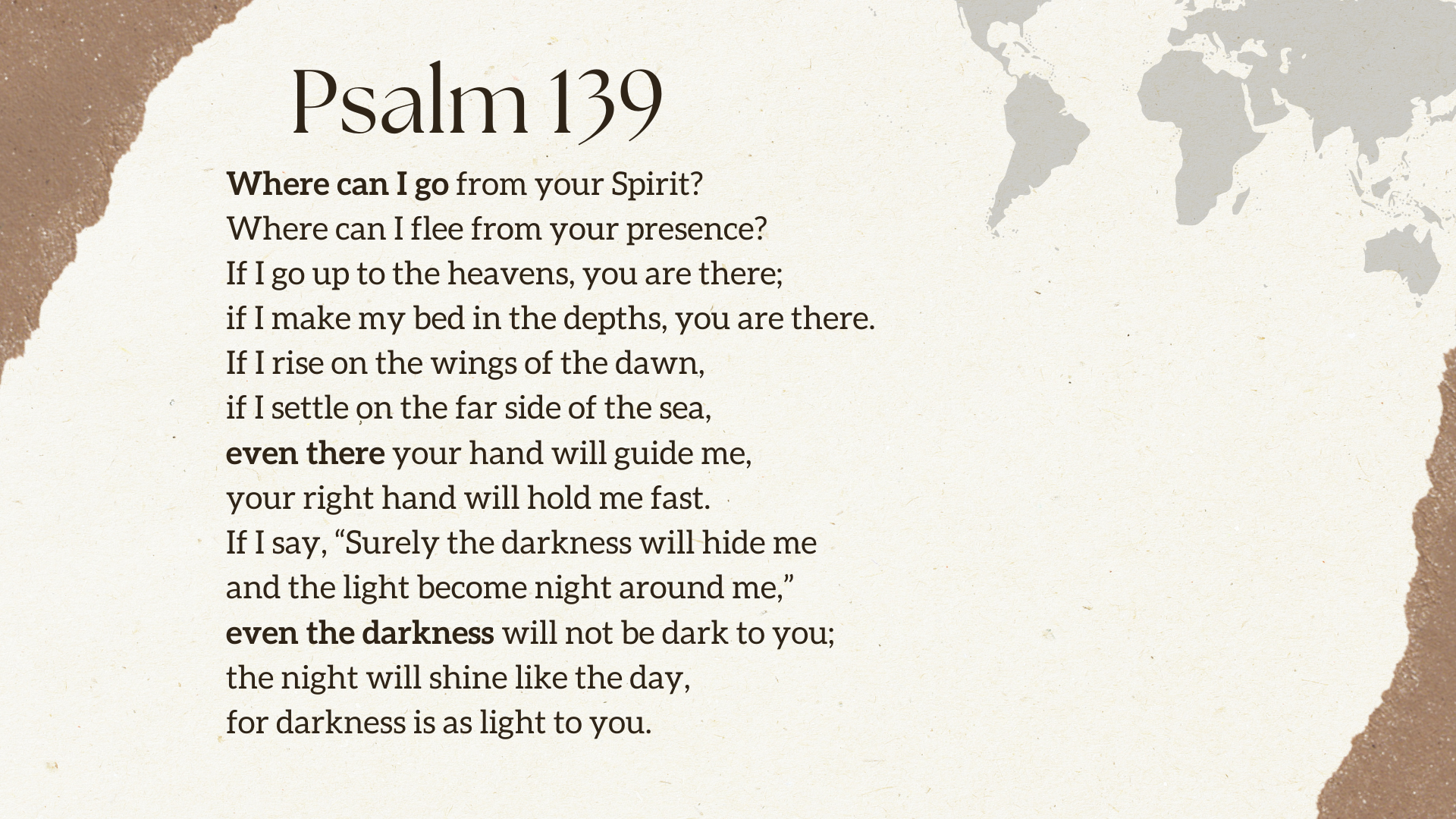
In Psalm 139, the psalmist asks, “Where can I go from your Spirit? Where can I flee from your presence?” The answer is nowhere. Whether we find ourselves in the heights of heaven or the depths of despair, God is there.

Jesus offers a similar promise in John 14. As he prepares his disciples for his departure, he tells them not to let their hearts be troubled. He reminds them of their connection to him and promises the presence of the Holy Spirit. Then he says:

“Peace I leave with you; my peace I give you.”
John 14:27

Jesus does not promise his disciples a life without uncertainty or difficulty. Instead, he reminds them of a relationship that will remain even when everything around them changes.

This is the foundation of the peace we are exploring together. We are on a remarkable journey, one that will take us through seasons of joy, uncertainty, growth, and even despair. And God is with us every step of the way.

We experience peace when we know God is with us.

Why We Need a Map

If God is with us wherever we go, why do we sometimes struggle to find peace?

One reason is that we can lose our bearings. When we don't understand where we are or what is happening within us, we can feel confused, discouraged, or even hopeless.

Much like a journey through Middle-earth in The Lord of the Rings, to follow Frodo and Sam, we need some sense of where they are, what lies ahead, and how their path relates to the journeys of the other characters. Without that understanding, it's easy to lose track of the story.

Our spiritual journeys can feel much the same. We need ways to understand where we are, recognize what God may be doing in our lives, and appreciate how our journey relates to the journeys of others.

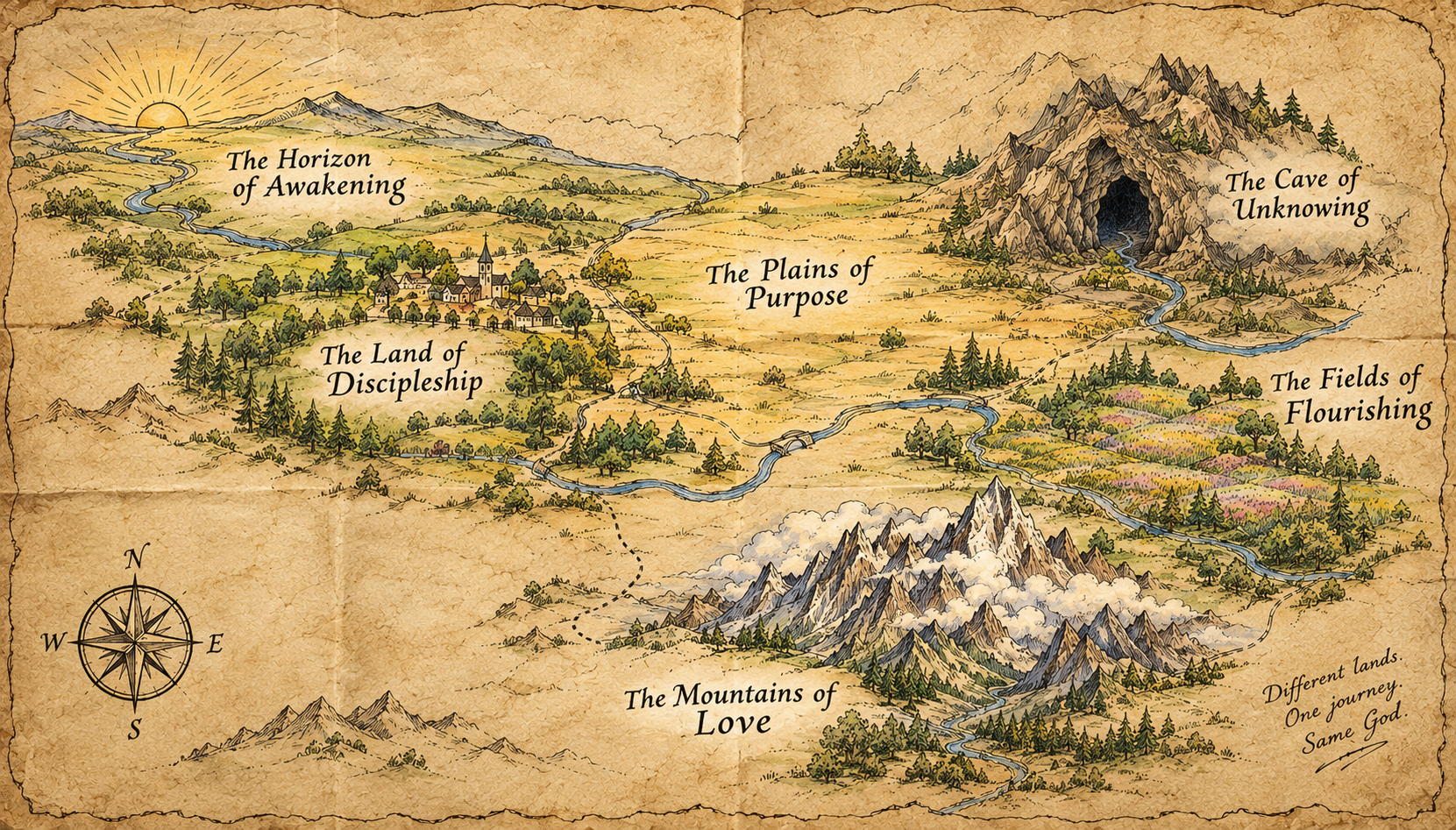
For this series, we're using a framework from Janet O. Hagberg and Robert A. Guelich's book The Critical Journey: Stages in the Life of Faith. It offers a map for understanding different experiences of spiritual growth.

But there is an important distinction: this is not a ladder we climb to become better Christians. It's a map that helps us understand where we are.

Different Places, One Journey

Rather than calling these experiences stages, we're going to call them lands or locations. The language matters because a numbered list can make it seem as though one location is better than another. But every location has its own gifts and challenges.

We also don't all travel the same road.

We may visit a place several times before settling there for a season. Circumstances may take us back to familiar territory, even after we've experienced something new. Two people can be the same age, share similar life circumstances, and attend the same church while experiencing very different things spiritually.

Our perspective is limited, too. When we're standing in one place, we may not be able to understand what someone a few destinations away is experiencing.

That can create tension. We may judge someone for not seeing what seems obvious to us, or wonder why a practice that once brought us peace no longer seems to help. We may even mistake someone else's spiritual season for a lack of faith.

A map doesn't solve every disagreement. But it can help us approach one another with greater patience and curiosity.

Storing up peace is a shared journey. We each have a part to play, and we can better appreciate one another when we recognize that we're not all standing in the same place.

Our First Stop: The Land of Discipleship

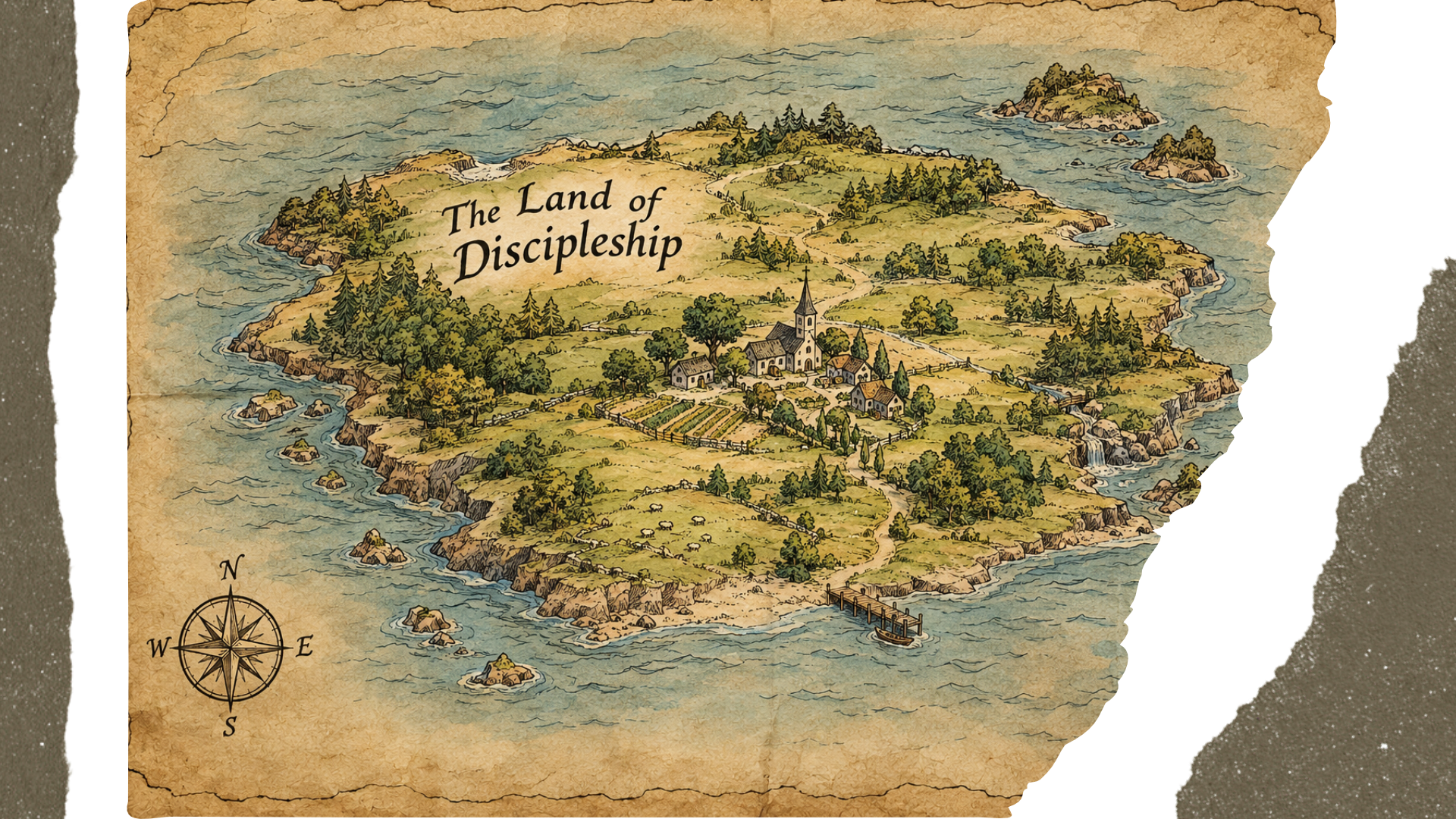
We began our exploration in what we're calling the Land of Discipleship, a place characterized by learning and belonging.

Here, faith begins to take shape in everyday life. We learn what it means to follow Jesus, not simply believe in him. We establish rhythms of worship, prayer, Scripture, service, and community. We give our time and resources, find ways to serve, and discover what it means to belong to a people who are learning to follow Jesus together.

Acts 2:42–47 offers a beautiful picture of this kind of life. The early Christians devote themselves to teaching, fellowship, breaking bread, and prayer. They share what they have, care for one another, and gather regularly.

In Romans 12:9–13, Paul describes the love that grows within such a community: genuine affection, service, generosity, patience, and hospitality.

Together, these passages remind us that we aren't meant to figure out the life of faith on our own. We learn by participating in a community that is also learning to follow Jesus.

There is real peace to be found here.

  • A foundation: We begin to understand what following Jesus looks like in everyday life.
  • A community: We discover that we aren't meant to make this journey alone.
  • A rhythm: Practices like prayer, Scripture, worship, and service help us return to God again and again.
  • A purpose: We find ways to participate in what God is doing in the world.
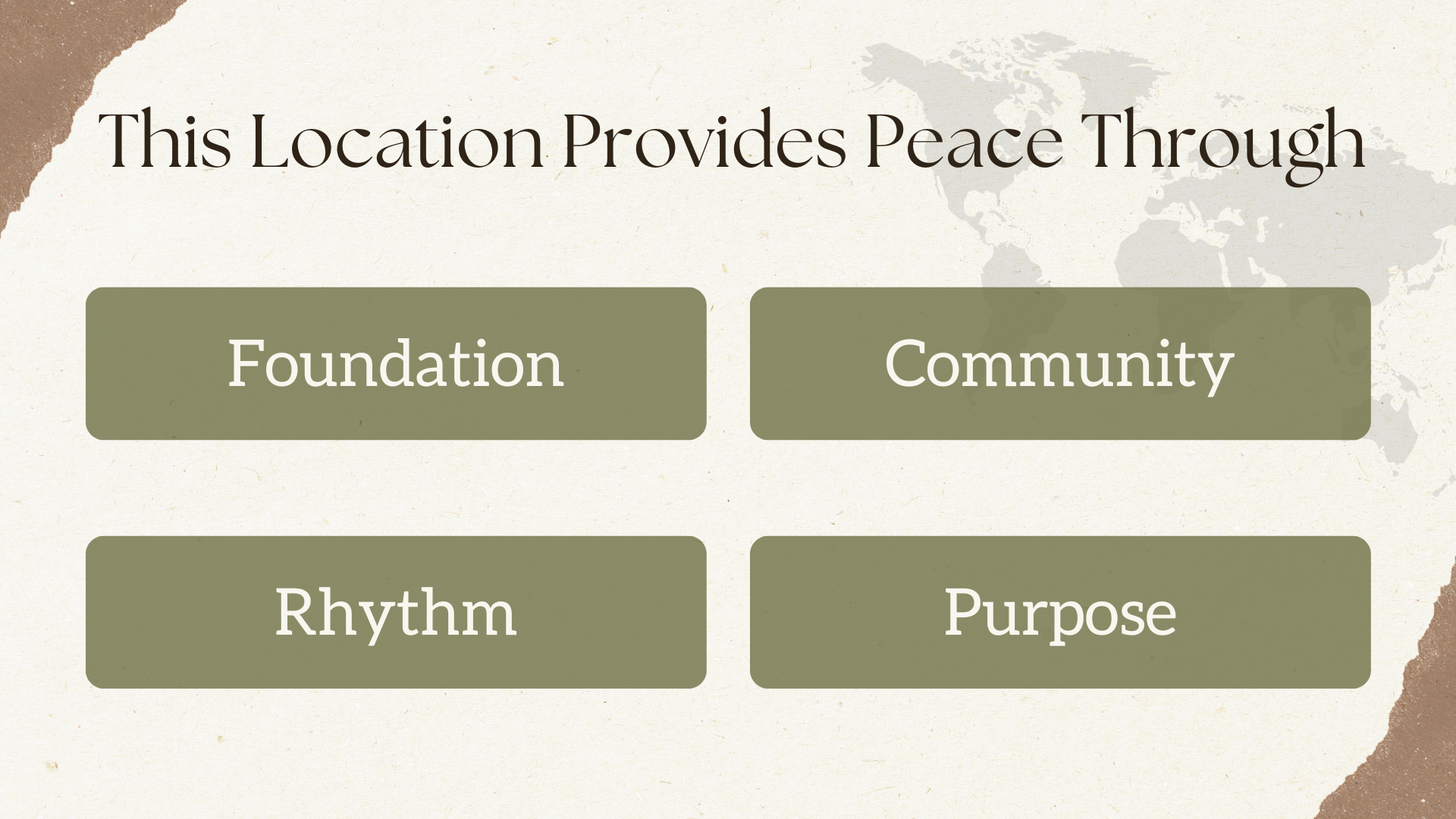
If this were Middle-earth, the Land of Discipleship might feel a little like the Shire: familiar, welcoming, and full of the comforts of home.

And there is nothing wrong with that. These practices and relationships give our faith roots. They help us learn to love God and our neighbors through the ordinary rhythms of life.

But as we'll discover in the weeks ahead, even good things can become complicated when we lose sight of the relationship at the heart of them.

Wherever You Are, God Is With You

Over the coming weeks, we'll explore other locations on this map. Some may feel familiar and life-giving. Others may feel disorienting, lonely, or difficult to navigate.

The goal isn't to decide which location is best or to force ourselves toward a particular destination. It's to recognize where we are, look for what God is doing, and learn to live faithfully along the journey.

So, wherever you find yourself today, consider these questions:

  • When have you experienced a deep sense of peace? What was happening in your life?
  • When has peace seemed far away? What made it difficult to find?
  • How might understanding your own spiritual journey help you extend greater grace to someone else's?

You don't have to have the whole journey figured out. You don't have to be in the same place as the person sitting next to you.

You simply need to remember that you are not traveling alone.

Take It Into Your Week

  • Go for a walk. Ask God to bring to mind a time when you experienced peace. What was happening in your life? What helped you recognize God's presence?
  • Spend some time journaling. Recall a time when peace seemed far away. What made peace difficult to find? What were you experiencing, and where did you turn for help?
  • Practice noticing. Over the next few days, pause when you feel peaceful, unsettled, or somewhere in between. What is happening within you? What might God be inviting you to notice?

Wherever we are on the journey, God is with us.

Up Next
From this Collection: Adult Education
November 16, 2026 • 6 Minute Read
Keep The Faith: A Study of 1 and 2 Thessalonians
What happens when something is crushed? If you take a handful of marbles and crush them, you get something sharp and broken. But if you take a cluster of grapes and crush them, you get something entirely different. You get something that can nourish and refresh. The difference is in what was there to begin with. In his second letter to the church in Thessalonica, the apostle Paul writes to a congregation that was experiencing the pressure of persecution. Like a cluster of grapes caught in a winepress, they were being squeezed by difficult circumstances. Yet what was emerging from their lives was something remarkable. Their faith was growing, their love for one another was increasing, and their perseverance was becoming an example to others. Paul begins his letter with words of affirmation: We ought always to thank God for you, brothers and sisters, and rightly so, because your faith is growing more and more, and the love all of you have for one another is increasing. Therefore, among God's churches we boast about your perseverance and faith in all the persecutions and trials you are enduring. 2 Thessalonians 1:3–4 Those are powerful words, especially when we consider what this congregation had been through. A Church Under Pressure The church in Thessalonica was relatively young. Paul had spent only a short time there before circumstances forced him to leave. We learn about those events in Acts 17. Opposition arose against Paul and his companions, and the situation became so difficult that Paul had to move on. He was concerned about this young congregation and what might happen to their faith after his departure. Would they remain faithful? Would they continue to grow? Would the difficulties they faced become too much for them? We get a glimpse of Paul's concern in his first letter to the Thessalonians. He encouraged them to remain faithful and reminded them of the hope they had in Jesus Christ. He even prayed that God would strengthen their hearts so they would remain blameless and holy in his presence (1 Thessalonians 3:13). The two letters were likely written relatively close together. Yet some confusion had developed within the church. In particular, there were questions about the Day of the Lord and whether it had already come. Paul wanted to clear up these misconceptions. Some had become shaken and disturbed by what they were hearing. Others apparently had begun to neglect their responsibilities, perhaps believing there was little reason to continue their ordinary work if the Lord's return was imminent. Paul addresses those concerns throughout his second letter. He offers affirmation in chapter one, explanation in chapter two, and exhortation in chapter three. But before addressing their confusion, he wants them to understand something important: He sees what God is doing among them. Looking for God in the Valleys One of the remarkable things about Paul's words is that he doesn't begin by focusing on everything that is going wrong. He begins by giving thanks. Despite their challenges, the Thessalonians were seeing their faith grow and their love for one another increase. Their circumstances had not prevented God from working in their lives. It raises some important questions for us. Reflection When we find ourselves in the valleys of life, where do we look? Do we spend all our time looking back at the mountaintops, wishing we could return to easier days? Or can we learn to remain rooted in God even when the circumstances around us are difficult? Do we recognize God's presence only when life is going well, or do we trust that He is with us in the difficult seasons, too? Psalm 121 begins with a familiar question: I lift up my eyes to the hills. Where does my help come from? The answer follows: My help comes from the Lord, the Maker of heaven and earth. Psalm 121:1–2 The psalmist doesn't suggest that the hills themselves are the source of our help. Our help comes from the Lord. The God who made heaven and earth is present with us, even in the valleys. Sometimes we need to remember that God is not only present during the good seasons of life. He is present in the difficult ones as well. A Faith That Continues to Grow The Thessalonians' example reminds us that difficult seasons do not have to be wasted seasons. Paul recognized this in their lives. He could see that their circumstances had not defined them. Their faith and love were continuing to grow, even while they endured persecution. Paul writes about this same hope in Romans: I consider that our present sufferings are not worth comparing with the glory that will be revealed in us. Romans 8:18 And in 2 Corinthians, he reminds us: For our light and momentary troubles are achieving for us an eternal glory that far outweighs them all. 2 Corinthians 4:17 These passages aren't meant to minimize the pain of suffering. Paul knew what suffering looked like. He had experienced persecution, hardship, and uncertainty himself. But he also understood that what we experience in the present is not the whole story. There is something greater ahead of us. When we keep our eyes on God, our circumstances do not have to determine the direction of our faith. We can continue to grow, continue to love one another, and continue to be an encouragement and example to those around us. That's what Paul saw happening in Thessalonica, and he wanted them to know that he noticed. Perhaps that's an important lesson for us, too. Sometimes people who are walking through difficult seasons need more than advice or explanations. They need someone to recognize their faithfulness, encourage their perseverance, and remind them that God is still at work. The Thessalonians were not without difficulties. But their faith was growing, their love was increasing, and their perseverance was becoming an example to others. As we look at the example of the Thessalonian church, we should ask ourselves what others see in us when life gets difficult. Reflection Are our faith and love continuing to grow? Are we encouraging those around us through our perseverance? And are we helping others see that God remains faithful, even in the valleys of life? Paul saw something worth affirming in the Thessalonians. Our prayer today is that we learn to recognize and encourage that same kind of faithfulness in the people around us at Northside.
November 16, 2026 • 2 Minute Read
A Prophetic Perspective On Purpose
At certain points in life, our reflections on meaning, purpose, and the future become more intense. Certain seasons of life can bring these questions to the surface: reaching age milestones, children growing beyond elementary school, new responsibilities at work or home, and aging family members, to name a few. When these seasons arise, there is wisdom in digging into the reflection, exploring the unknown and discovering what might be revealed through vulnerability. For me, this season appeared in the form of a question: “What is it that You want from me, God?” When things do not go my way, when I do not feel a sense of accomplishment, and when sadness crowds the day, this is the question that comes to mind. Does what I am doing even matter? When I asked this question of God, a passage from the prophet Micah came to mind. This is not an obscure passage in the Bible. In fact, it is probably one of the most quoted passages in the Old Testament. Yet frequent quotation does not mean a passage has been exhausted of meaning. It may be just the opposite. Familiarity can sometimes cloud significance. With all of this in mind, this is the beginning of a journey to uncover what treasures lie hidden in plain sight. What message did God speak through a prophet from Moresheth more than 2,500 years ago that still speaks to us? Each person handles times of reflection differently. I am going to share mine through these posts and classes. Diving deeply into the meaning, background, and text of Scripture has proven valuable to me. That is my way of reflecting, and my hope is that this journey may be helpful to you as well. Perhaps we can travel together. There is no better place to start than Micah 6:8. Read it slowly, read it carefully, and see what stands out to you. No, O people, the Lord has told you what is good, and this is what he requires of you: to do what is right, to love mercy, and to walk humbly with your God. Micah 6:8 (NLT)
October 20, 2026 • 13 Minute Read
Storing Up Peace: When Purpose Challenges Peace
When Purpose Challenges Peace In our second week, we explored the Land of Discipleship and the ways that the rhythms of faith, church, Scripture, service, and community can give our lives meaning. We also considered how the good things about this land can develop a shadow side, eventually turning our homeland into an island. Through our fictional friends Joe and Susie, we began to see how two people can share the same church community while experiencing their faith in very different ways. This week, we're adding two more friends to the journey: Dave and Charlotte. Like Joe and Susie, they have different experiences of faith, different expectations, and different ideas about what it means to follow Jesus. Fixing Our Thoughts on God But before we meet them, I want to invite you to do something a little different, starting with this beautiful reminder from Isaiah: You will keep in perfect peace all who trust in you, all whose thoughts are fixed on you! Isaiah 26:3 Regardless of where we find ourselves on the spiritual journey, we need to continually fix our thoughts on God. Sometimes that means slowing down long enough to notice what's happening within us. To recognize where we are experiencing the presence of God's Spirit and where we may be struggling to see it. One way to do this is through a simple spiritual temperature check. Spiritual Temperature Check Take a few minutes to become still. Find a quiet place, take a few slow breaths, and invite God to help you pay attention to your spiritual life. You might begin with a simple prayer: God, help me see what is happening within me. Show me where your Spirit is bearing fruit, where I am growing, and where I may need your presence and guidance. Then slowly consider the fruit of the Spirit described in Galatians 5:22–23. Love Joy Peace Patience Kindness Goodness Faithfulness Gentleness Self-control As you reflect on each quality, consider how present it seems in your life right now. You might mark each one as strong, neutral, or weak. Don't overthink your answers, and resist the temptation to grade yourself. This isn't a spiritual report card. It's simply an opportunity to notice what's happening within you. Where are you experiencing the fruit of the Spirit? Where might you be longing for more? If you're comfortable, take a moment to write down what stands out. You might even share one or two observations with someone you trust. As you finish, consider whether there is a connection between the fruit you're experiencing and your sense of spiritual peace. Sometimes we discover that we're experiencing a deep sense of peace even in the midst of difficult circumstances. Other times, we realize that something has been disrupting our peace, perhaps without our fully recognizing it. The goal isn't to manufacture peace or force ourselves to feel a certain way. It's to become more attentive to what is happening within us and to invite God to expand our awareness. New Friends and New Homelands Let's return to our map of the spiritual journey. This week, we're introducing two new friends who call very different places home. First, meet Dave. Dave is a brand-new follower of Jesus. He didn't grow up in the church, and he had a rough go of it during his teens and early twenties. But when he discovered Jesus, it was like someone had hit the reset button on his life. His past was behind him, and each day felt like a tremendous gift. Now he's enthusiastic about the future and eager to share the life-changing secret of knowing Jesus. Dave calls the Horizon of Awakening home. Now meet Charlotte. (if you haven’t noticed our AI image generator loves to dress people in olive green) Charlotte has known about Jesus for a long time. She comes from a family of faithful parents and grandparents and has been attending church for as long as she can remember. When her children were born, she couldn't wait for the church to bless each new child. Now those little babies are nearly grown, and it seems like Senior Sunday was just around the corner! Over the years, Charlotte has also found meaningful ways to serve. She sings on the praise team, volunteers in multiple ministries, and even started a brand-new ministry at church a few years ago. She loves being involved and finds great purpose in using her gifts to serve others. Charlotte calls the Plains of Purpose home. Dave and Charlotte have very different experiences of faith. Neither is necessarily better or worse. But the place they call home shapes what they notice, what they value, and what they expect from their life with God. That can shape the ways they experience and store up peace. Take a moment to imagine how Dave and Charlotte might respond to the spiritual temperature check we just completed. What qualities might stand out in each of their lives? What might they be experiencing differently? Remember, these homelands aren't rankings, and they aren't a measure of how close someone is to God. They simply help us recognize the different ways people experience and live out their faith. The Plains of Purpose When we move from learning and practicing our faith to actively putting our gifts to work, we may find ourselves traveling into what Hagberg and Guelich describe as the Productive Life. We're calling this place the Plains of Purpose. This is the doing stage. Having spent time learning to follow Jesus, we begin to feel ready to take on more responsibility. We discover our gifts, find opportunities to serve, and begin to lead others. We teach classes, lead ministries, organize events, care for people, and take on responsibilities within the church and beyond it. This can be an exciting and fulfilling time in our faith. We see the difference our efforts can make. We feel useful. We find purpose in using our gifts to serve God and others. Our faith isn't just something we believe or practice. It becomes something we actively do. Think about someone who has spent years participating in a church community and finally agrees to teach a Bible class. Or someone who has served behind the scenes and is invited to lead a ministry. Maybe it's a young adult who begins to recognize their gifts and discovers how those gifts can make a difference in the lives of others. These can be wonderful experiences. We experience the joy of serving, the satisfaction of seeing something grow, and the fulfillment of knowing that we're contributing to something bigger than ourselves. Now think about Charlotte. She has spent a lifetime in the church, raised her children in the community of faith, found meaningful ways to serve, and even helped create a new ministry. These things aren't just activities on her calendar. They're part of how she understands her faith and her relationship with God. She finds purpose in using her gifts, and she experiences the joy of seeing those gifts make a difference. The Plains of Purpose can be a place of deep peace because we find meaning in using our lives to serve God and others. But there's a tension here. The very things that make this stage so fulfilling can also become sources of struggle. The things that bring us purpose and peace can also become the things we expect everyone else to value. And when they don't, we may begin to misunderstand one another. Charlotte may not even realize she's doing it. What has become meaningful and life-giving to her may begin to feel like the natural expectation for everyone else. Think about how that might affect her relationship with someone like Dave. She may appreciate his enthusiasm and new love for Jesus, but she might also wonder why he isn't more involved in the life of the church. Why isn't he serving? Why isn't he taking advantage of the opportunities available to him? From Charlotte's perspective, these things are simply part of what it means to live faithfully. But Dave is experiencing something different. He's still discovering the joy of knowing Jesus. His excitement isn't necessarily expressed through the same responsibilities or activities that have become meaningful to Charlotte. Our experience of faith can shape what we expect from others, sometimes without our even realizing it. When Purpose Becomes a Source of Struggle When our work is going well, we may begin to expect that it will continue to go well. We assume that if we work hard enough, pray faithfully enough, or lead well enough, we'll see the results we hope for. We may also begin to tie our sense of worth to what we accomplish. We feel close to God when our work is fruitful, but wonder what has gone wrong when it isn't. We might become frustrated when people don't change, when our efforts go unnoticed, or when someone else is chosen to lead. We may even begin to expect everyone else to work as hard as we do. The work itself isn't necessarily the problem. Serving God and others is good. But our relationship with that work can change. We can begin to measure our faithfulness by what we accomplish, or measure the faithfulness of others by how much they contribute. What once brought us joy and purpose can become a source of pressure, frustration, and even resentment. There are many stories throughout scripture that reflect this reality, but one of my favorite examples is from the Gospels. Martha and Mary As Jesus and his disciples were on their way, he came to a village where a woman named Martha opened her home to him. She had a sister called Mary, who sat at the Lord's feet listening to what he said. But Martha was distracted by all the preparations that had to be made. She came to him and asked, "Lord, don't you care that my sister has left me to do the work by myself? Tell her to help me!" "Martha, Martha," the Lord answered, "you are worried and upset about many things, but few things are needed, or indeed only one. Mary has chosen what is better, and it will not be taken away from her." Luke 10:38–42 It's easy to read this story as a warning against being busy. But Martha's hospitality isn't bad, and serving others isn't the problem. We might imagine Martha as someone who would feel right at home in the Plains of Purpose. She knows how to serve, she sees what needs to be done, and she takes responsibility for making things happen. Those are good qualities. The tension emerges when Martha becomes so caught up in what needs to be done that it begins to affect her relationship with Jesus and with Mary. Martha becomes frustrated and asks Jesus to tell Mary to help her. From her perspective, Mary isn't doing what she should be doing. She's not sharing the responsibility, and Martha feels left alone to carry the load. It's possible that Charlotte would relate to Martha. She knows what it takes to make things happen. She has spent years serving, leading, and taking responsibility. But what happens when she begins to measure her own faithfulness, or the faithfulness of others, by how much they're doing? We can experience something similar in our own lives. We can become so focused on serving God that we lose sight of the God we are serving. We can become so invested in doing good things that we struggle when others don't share our priorities or when our efforts don't produce the results we expected. The question isn't whether we should serve. It's what happens within us as we serve. Finding Our Way Back to Peace The Plains of Purpose isn't a place we need to avoid. Using our gifts, serving others, and accepting responsibility can be meaningful expressions of our faith. We shouldn't confuse the challenges of this homeland with a reason to abandon the good things God is doing through us. Instead, we need to pay attention to what is happening within us. Are we serving out of love, or are we trying to prove our worth? Are we finding joy in what God is doing, or becoming frustrated because things aren't going the way we planned? Are we able to appreciate the different ways others are following Jesus, or have our own expectations become the standard by which we measure everyone else? These are important questions, especially when we find ourselves losing the peace we once experienced in serving God. Remember the spiritual temperature check we began with? This is a good place to return to it. Practice: Returning to the Source Take another look at the fruit of the Spirit. Have any of your observations changed as you've reflected on the Plains of Purpose and the story of Martha and Mary? Perhaps you recognize that your patience has been wearing thin. Maybe you've been struggling with joy because your efforts haven't produced the results you hoped for. Or perhaps you've realized that you've been so busy caring for others that you've neglected your own relationship with God. Whatever you notice, resist the urge to immediately fix it or turn it into another project. Instead, bring it honestly before God. You might spend a few minutes praying with these questions: Where am I finding purpose and joy in serving God and others? Where might my work or responsibilities be becoming a source of frustration or pressure? Am I measuring my worth, or the worth of others, by what we accomplish? What might it look like to sit at the feet of Jesus again, remembering that my relationship with God is not dependent on what I do? You might even spend some time simply sitting in silence, releasing the things you feel responsible for and receiving the reminder that you are loved by God apart from what you accomplish. The goal isn't to do less for the sake of doing less. It's to remember why we do what we do in the first place. The peace we find in serving God isn't ultimately found in how much we accomplish, how much responsibility we carry, or how successful our efforts become. It comes from our relationship with the God we are serving. Learning to Appreciate Different Journeys As we close this week, I want to return to our four friends: Joe, Susie, Dave, and Charlotte. Each of them calls a different place home. Each has different experiences, different expectations, and different ways of understanding what it means to follow Jesus. What brings one person peace might frustrate another. And sometimes the people who could help us find peace are the very people we struggle to understand. Perhaps one of the most important things we can learn along this journey is to appreciate what God is doing in someone whose experience of faith looks different from our own. We don't all need to be in the same place. We don't all need to express our faith in the same way. And we certainly don't need to measure someone else's journey by the expectations we've developed along our own. Wherever we find ourselves, we can continue learning to fix our thoughts on God, trusting that God is with us and is still at work within us. You will keep in perfect peace all who trust in you, all whose thoughts are fixed on you! – Isaiah 26:3
October 20, 2026 • 10 Minute Read
Storing Up Peace: When Discipleship Becomes an Island
Storing Up Peace: When Discipleship Becomes an Island Last week, we introduced the idea that we are all Hobbits. Well, not exactly, but like Hobbits, we are on a journey. Not through Middle Earth, but through our faith. We are on a spiritual journey. Like any journey, we find ourselves in different places along the way. Sometimes we know exactly where we are. Other times, the landscape is unfamiliar, and we're not quite sure what comes next. We also talked about an important truth that runs throughout this series: There is nowhere we can go and not be in God's presence. The psalmist reminds us: “If I rise on the wings of the dawn, if I settle on the far side of the sea, even there your hand will guide me, your right hand will hold me fast.” Psalm 139:9–10 Jesus offers a similar assurance to his disciples: “Peace I leave with you; my peace I give you.” John 14:27 These promises are important because our spiritual journeys don't all look the same. We won't always understand where we are, what God is doing, or why someone else's journey looks so different from our own. But we can trust that God is present along the way. This week, we returned to the Land of Discipleship, exploring both the good that can be found there and the dangers present when we become stuck. The Benefits of Discipleship The Land of Discipleship can feel like the Shire on a warm, sunny day. It is a place many of us know well. It's where following Jesus begins to take on a new significance in our lives. We want to learn more about God, understand Scripture, develop spiritual practices, and spend time with others who share our faith. We discover the joy of Bible study, the importance of community, the gifts that come through service, opportunities to participate in God's mission, and rhythms of worship that carry our faith into everyday life. These are beautiful things! For some, this enthusiasm might look like sharing a meaningful Instagram video with friends. For others, it might look like gathering at the church building on Tuesday morning for Bible study. The expressions may be different, but the desire is similar: we want to grow in our understanding of God and share what we're discovering with others. What's important to remember is that these practices aren't limited to one season of life. We can continue learning, growing, worshiping, and serving whether we're 17 or 70. The Land of Discipleship is a place where following Jesus has become a meaningful part of who we are. Reflection Take a moment to consider your own life. What practices, relationships, or experiences have helped you discover the joy of following Jesus? Where have you experienced the goodness of discipleship? When We Experience the Journey Differently But what happens when someone else's experience of faith looks very different from our own? Imagine two people attending the same church. Our first friend is Joe. He has spent years building his faith around the rhythms of church, Scripture, service, and community. Those things have been, and continue to be, life-giving for Joe. Then one day, Joe encounters Susie. She's asking questions about her faith that she hasn't asked before. Some of the familiar practices of church life no longer carry the same meaning they once did. Gathering at church often feels more isolating than uplifting. Joe struggles to understand how Susie could question or walk away from something that has been so important to him. Or imagine the reverse. Susie looks at Joe and sees someone who seems perfectly content with the familiar rhythms of church life. She begins to wonder if he's ever wrestled with the deeper questions of faith. In both cases, they are looking at someone else's journey and struggling to make sense of it because they are seeing it exclusively from their own location. And just like that, peace begins to feel very distant. This is one reason I believe a map is helpful. The map doesn't tell us that every decision someone makes is right. It doesn't mean we'll always agree with one another, or that we can fully understand another person's experience simply by identifying where they are. But it can remind us that we don't see the whole landscape. Someone else's experience may be different from ours without being meaningless. Their journey may look unfamiliar without being outside God's presence. When we cannot understand ourselves or one another, we can begin to lose our peace. We may wonder whether we've lost our way, whether someone else has lost theirs, or whether God is still at work. The map gives us a way to reorient ourselves. We can pause, recognize where we are, look for what God is doing there, and learn to live faithfully in that place. We can remember that, even when we don't understand someone else's journey, we are part of the same story. God is with us along the way. When a Land Becomes an Island There is something else we need to consider about the Land of Discipleship. In The Critical Journey, Hagberg and Guelich describe how this land can become an island. It can become very tempting to believe that what is right for us in our faith is what is right for everyone else, too. The very things that helped us grow can become things we use to measure someone else's faithfulness. Our familiar practices become expectations for everyone. Our community becomes an exclusive circle. Our understanding of Scripture becomes something we use to prove we're right. The problem isn't the practices themselves. It's what they are forming in us. Consider some examples: Bible study can deepen our love for God, but it can also become a way to prove we're right. Community can teach us to love others, but it can also become an exclusive circle of people who think like us. Service can reveal gifts we didn't know we had, but it can also become a source of identity or status. The same activities that help us grow can also reinforce what we already know and protect what makes us comfortable. One of the more striking biblical examples of this comes from Jesus' parable of the prodigal son. It's a story worth spending a little time with as we consider what it means to become stuck. In Luke 15:25–32, the older son returns from working in the fields to discover that his younger brother has come home. Rather than celebrating, he becomes angry. He reminds his father of his years of faithful service and cannot understand why his brother is receiving such a celebration. Before we quickly condemn the older son and his failings, I think it's important to recognize there seems to be faithfulness present. There's something admirable about his commitment to his father and his responsibilities. He has been consistent, dependable, and trustworthy. But somewhere along the way, his sense of faithfulness has become a barrier to celebrating his brother's return. He is so focused on what he believes is fair that he cannot recognize the grace unfolding right in front of him. It's a sobering picture of what can happen when we become stuck. A Reflection from Scripture Read Luke 15:25–32 and consider these questions: What is admirable about the older son's commitment to his father and his responsibilities? How does his sense of faithfulness become a barrier to celebrating his brother's return? Be careful not to rush to judgment. Take some time to recognize both the goodness in the older son's faithfulness and the ways it has become an obstacle. Becoming stuck isn't always so obvious. Sometimes it looks like resentment toward someone who receives grace we believe is undeserved. Other times, it can take on a much more damaging form, when we become so convinced we're defending God that we can no longer recognize what God is doing. Learning to Recognize the Spirit So how do we continue growing? How do we recognize when the things that once helped us follow Jesus are beginning to hold us back? The letter of 1 John offers some helpful guidance. John encourages the church to test the spirits, to love one another, and to remember that perfect love drives out fear (1 John 4:1, 7, 18–21). That gives us an important question to carry into our own spiritual lives: Are my spiritual practices helping me grow in love, or are they helping me feel more secure in being right? This isn't an invitation to abandon the practices that have shaped our faith. Quite the opposite. It's an invitation to let those practices continue doing what they were meant to do: draw us closer to God and form us into people who love others. I encourage us all to take some time this week to sit with that question. You might bring it into your next time of Bible reading, prayer, or reflection. As you consider the people you disagree with or struggle to understand, ask God to help you see them with greater love and curiosity. We know disagreements are coming. Misunderstandings are inevitable. Relationships will be challenging. And yet, God is present. Holding On to the Good I don't want us to leave the Land of Discipleship thinking it's a bad place to be. There is so much good here! Following Jesus brings a new enthusiasm for learning, growing, worshiping, serving, and sharing life with others. We should celebrate those things and continue to make room for them in our lives. But we also need to remain open to the possibility that God is inviting us into something more. There is no set amount of time we should spend in any particular land. What matters is following the leading of the Holy Spirit. If the Spirit says stay, we stay. If the Spirit says go, we must be ready to go. Paul offers this encouragement to the church in Thessalonica: We can hold on to the good found in the Land of Discipleship, reject the things that keep us stuck, and remain open to the ever-expanding work of the Spirit in our lives. That's part of what it means to be on a journey. And perhaps it's also part of what it means to store up peace: learning to trust that God is at work in places we understand and places we don't, in people whose faith looks familiar and people whose journeys look very different from our own. One Story to Love Them All We are all part of the same story. And God is with us along the way. Next week, we'll explore what happens when God invites us beyond the Land of Discipleship and into the Plains of Purpose. We'll consider how our relationship with God continues to grow and how the things that once brought us peace can begin to change.
October 20, 2026 • 7 Minute Read
Storing Up Peace: The Journey Begins
Storing Up Peace: The Journey Begins What if finding peace begins with remembering that God is with us, wherever we are on the journey? “When I experienced peace I knew God was with me.” Those words from Kellie White recently gave me a way to express what I hope we will discover together over the next several weeks. We often think of peace as the absence of conflict, the resolution of a problem, or the moment when life finally settles down. But what happens when the problem remains, the conflict continues, or life takes us somewhere we never expected to be? Can we experience peace even there? I believe we can. Storing up peace for our spiritual journey begins with realizing, or remembering, that God is with us. God Is With Us, Wherever We Go Read Psalm 139 Find a quiet place, or your favorite spot to spend time with God, and read all of Psalm 139 aloud. Read slowly. Pause whenever a line or phrase catches your attention, and spend a little time reflecting on it. When you finish reading, return to this post. In Psalm 139, the psalmist asks, “Where can I go from your Spirit? Where can I flee from your presence?” The answer is nowhere. Whether we find ourselves in the heights of heaven or the depths of despair, God is there. Jesus offers a similar promise in John 14. As he prepares his disciples for his departure, he tells them not to let their hearts be troubled. He reminds them of their connection to him and promises the presence of the Holy Spirit. Then he says: “Peace I leave with you; my peace I give you.” John 14:27 Jesus does not promise his disciples a life without uncertainty or difficulty. Instead, he reminds them of a relationship that will remain even when everything around them changes. This is the foundation of the peace we are exploring together. We are on a remarkable journey, one that will take us through seasons of joy, uncertainty, growth, and even despair. And God is with us every step of the way. We experience peace when we know God is with us. Why We Need a Map If God is with us wherever we go, why do we sometimes struggle to find peace? One reason is that we can lose our bearings. When we don't understand where we are or what is happening within us, we can feel confused, discouraged, or even hopeless. Much like a journey through Middle-earth in The Lord of the Rings, to follow Frodo and Sam, we need some sense of where they are, what lies ahead, and how their path relates to the journeys of the other characters. Without that understanding, it's easy to lose track of the story. Our spiritual journeys can feel much the same. We need ways to understand where we are, recognize what God may be doing in our lives, and appreciate how our journey relates to the journeys of others. For this series, we're using a framework from Janet O. Hagberg and Robert A. Guelich's book The Critical Journey: Stages in the Life of Faith. It offers a map for understanding different experiences of spiritual growth. But there is an important distinction: this is not a ladder we climb to become better Christians. It's a map that helps us understand where we are. Different Places, One Journey Rather than calling these experiences stages, we're going to call them lands or locations. The language matters because a numbered list can make it seem as though one location is better than another. But every location has its own gifts and challenges. We also don't all travel the same road. We may visit a place several times before settling there for a season. Circumstances may take us back to familiar territory, even after we've experienced something new. Two people can be the same age, share similar life circumstances, and attend the same church while experiencing very different things spiritually. Our perspective is limited, too. When we're standing in one place, we may not be able to understand what someone a few destinations away is experiencing. That can create tension. We may judge someone for not seeing what seems obvious to us, or wonder why a practice that once brought us peace no longer seems to help. We may even mistake someone else's spiritual season for a lack of faith. A map doesn't solve every disagreement. But it can help us approach one another with greater patience and curiosity. Storing up peace is a shared journey. We each have a part to play, and we can better appreciate one another when we recognize that we're not all standing in the same place. Our First Stop: The Land of Discipleship We began our exploration in what we're calling the Land of Discipleship, a place characterized by learning and belonging. Here, faith begins to take shape in everyday life. We learn what it means to follow Jesus, not simply believe in him. We establish rhythms of worship, prayer, Scripture, service, and community. We give our time and resources, find ways to serve, and discover what it means to belong to a people who are learning to follow Jesus together. Acts 2:42–47 offers a beautiful picture of this kind of life. The early Christians devote themselves to teaching, fellowship, breaking bread, and prayer. They share what they have, care for one another, and gather regularly. In Romans 12:9–13, Paul describes the love that grows within such a community: genuine affection, service, generosity, patience, and hospitality. Together, these passages remind us that we aren't meant to figure out the life of faith on our own. We learn by participating in a community that is also learning to follow Jesus. There is real peace to be found here. A foundation: We begin to understand what following Jesus looks like in everyday life. A community: We discover that we aren't meant to make this journey alone. A rhythm: Practices like prayer, Scripture, worship, and service help us return to God again and again. A purpose: We find ways to participate in what God is doing in the world. If this were Middle-earth, the Land of Discipleship might feel a little like the Shire: familiar, welcoming, and full of the comforts of home. And there is nothing wrong with that. These practices and relationships give our faith roots. They help us learn to love God and our neighbors through the ordinary rhythms of life. But as we'll discover in the weeks ahead, even good things can become complicated when we lose sight of the relationship at the heart of them. Wherever You Are, God Is With You Over the coming weeks, we'll explore other locations on this map. Some may feel familiar and life-giving. Others may feel disorienting, lonely, or difficult to navigate. The goal isn't to decide which location is best or to force ourselves toward a particular destination. It's to recognize where we are, look for what God is doing, and learn to live faithfully along the journey. So, wherever you find yourself today, consider these questions: When have you experienced a deep sense of peace? What was happening in your life? When has peace seemed far away? What made it difficult to find? How might understanding your own spiritual journey help you extend greater grace to someone else's? You don't have to have the whole journey figured out. You don't have to be in the same place as the person sitting next to you. You simply need to remember that you are not traveling alone. Take It Into Your Week Go for a walk. Ask God to bring to mind a time when you experienced peace. What was happening in your life? What helped you recognize God's presence? Spend some time journaling. Recall a time when peace seemed far away. What made peace difficult to find? What were you experiencing, and where did you turn for help? Practice noticing. Over the next few days, pause when you feel peaceful, unsettled, or somewhere in between. What is happening within you? What might God be inviting you to notice? Wherever we are on the journey, God is with us.